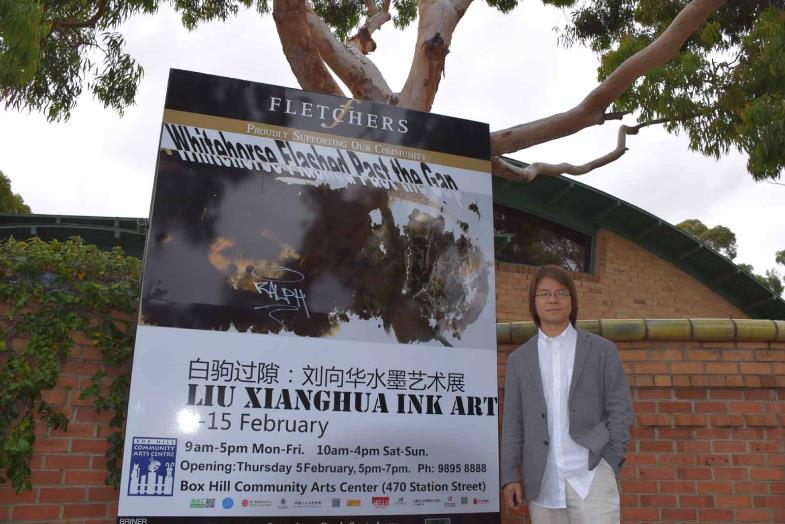
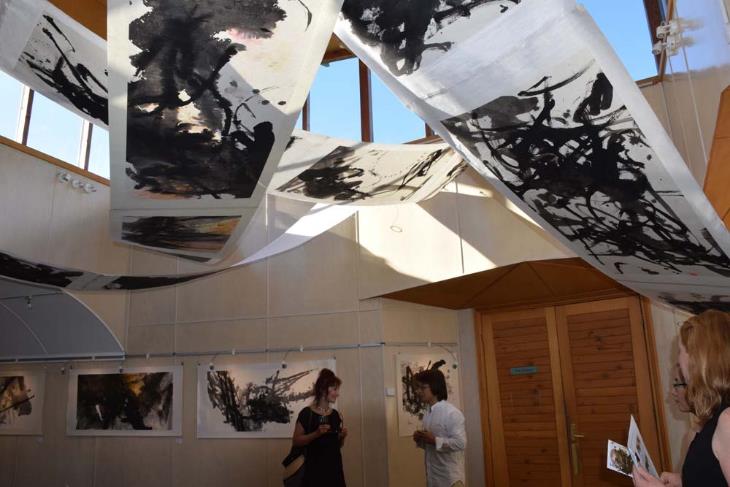
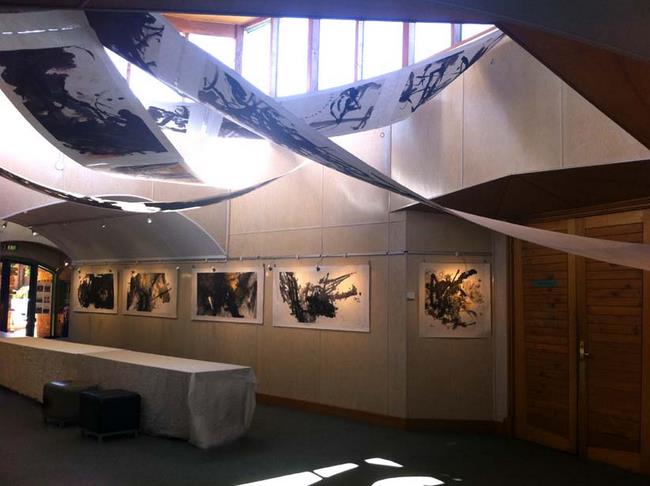
Feb 3 to 16, 2015, Liu Xianghua experimental ink art exhibition Whitehorse Flashed Past the Gap is opening at Box Hill Community Arts Centre. ‘White horse flashed past the gap’ is a familiar adage that speaks to Chinese about the fleeting of time. It first appeared in the classic Daoism text Knowledge Rambling in the North《知北游》, written by the great philosopher Zhuangzi (庄子) in the late 4th century B.C. from the Warring States period (战国). Famous for his metaphorical writing style, Zhuangzi uses the image of a darting horse to capture the moment rays of sunlight flicker through the cracks on the wall. In this way, the expression embodies vigor, immediacy and a dash of precariousness. Because of the richness derived from the interpretation of ‘White horse flashed past the gap’, it makes a perfect launching pad for visitors to appreciate Liu Xianghua’s artworks by contemplating their relativity of belonging in a split second.
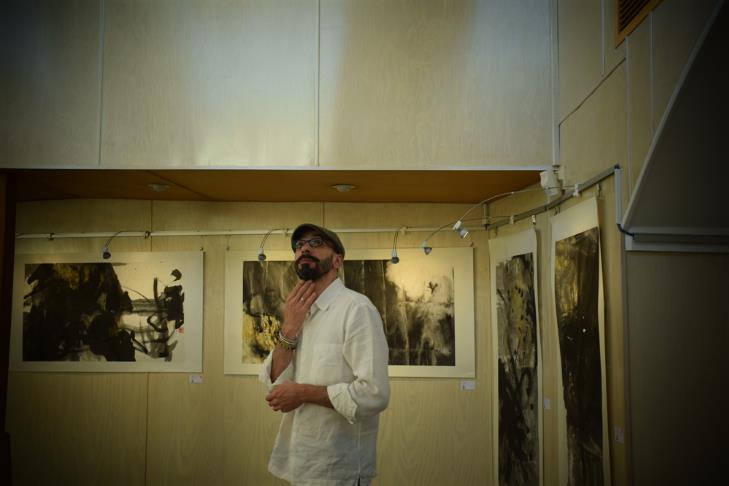
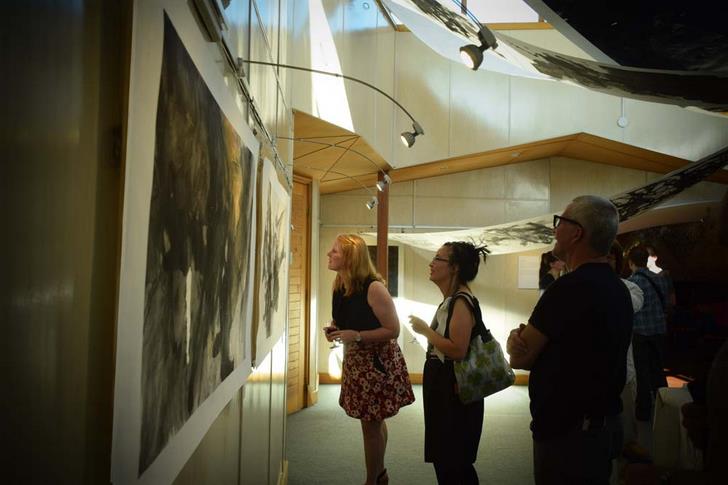
The solo exhibition provides a new perspective to the study of Chinese ink painting and writing tradition. From the perspective to evaluate the independent aesthetics of ink and brush, the exhibition features 37 paintings examining the artist’s experiment on the linear and spatial relations formed by ink, water and paper pushed into extremes. Liu Xianghua in his passionate artworks brings the discussion about relativity of time, space, belonging and identification to the fore, delving into the inter-constraint tension between people and the society with a strong response articulated.
Returning to the ink and brush tradition, the medium of Chinese painting and calligraphy, is a decision based on careful thinking. Ink and brush represent aesthetics that is utterly Chinese yet pales in responding the contemporaneity of China and Chinese people. In traditional Chinese paintings the value of ink and brush does not exist independently but attaches to the realistic depiction of images or conceptions the artist creates. Spirituality is often weaved into the depiction of something real, either in landscape or highly symbolized plants and flowers.
Years working as architect and interior designer have trained Liu into establishing order and form in any mediums at his disposal. The beauty of lines and the spatial structure formed appeals to him; the habit to analyze things nonetheless has regulated him to stay objective and look at things from afar. It is a chosen detachment. However since his arrival in Melbourne as a visiting scholar to Victorian College of the Arts in August, Liu finds himself dislocated and finds difficulty connecting to people, ideas and happenings. Communication has become a simplified yet complicated process of getting nowhere. It is an unintended disconnection. And it is due to this old and new experience of self-inflicted solitude and unexpected isolation, an unprecedented urge has ruptured in Liu and resulted in the artworks presented here – new ink art, structured with expressive strokes and layered tonalities that blur the boundary of painting and writing. Liu Xianghua has tested the relations between water, ink and paper, along with what these mediums are capable and incapable of, and their potential energy. Using or not using a brush, rubbing, peeling, the body, performance action or mixed materials, Liu is trying to renew the understanding of ink and brush paintings.
Moreover, Liu Xianghua has created an installation in the exhibition space. This installation is made up of 17 artworks which each could be appreciated individually. The idea to pull them together aims to subvert the traditional approach of reading a Chinese painting at a distance, from top downwards or bottom upwards. Suspended in mid air, the installation confuses the clarity of direction and the partition between horizontal and vertical, allowing the viewer to enjoy the installation from every angle. It therefore becomes an artwork of your own design by the way you choose to look at it.
The installation questions the relation of individuals as parts of a given collective. Also open for discussion is the ephemeral nature of the installation, which will only exist in this arrangement for the duration of this exhibition, to be de-installed and become something complete different in its next life. In the same way the penetrating sunlight forms the depth and width of space and time in ‘White horse flashed past the gap’, the installation circumvents freedom and constraint.
Article Written by Claire
Artist Biography:
Liu Xianghua was born in Hubei, China 1976. He receives his doctoral degree in art and design from Central Academy of Fine Arts. Before coming to Melbourne as a visiting scholar in Faculty of the VCA and Music at The University of Melbourne, Liu Xianghua teaches and researches in art of China’s traditional garden and national environmental art for ten years at Minzu University of China. In 2010, his installation Urban Forest, has featured in the exhibition ‘History Reconstructed-- China youth invitational exhibition" curated by Today Art Museum in Beijing.
Contact Artist
Email: suchang600@gmail.com
Phone:0438790908